How to Turn Returns into Retained Revenue on Shopify
Every return feels like a loss. A refund issued, a sale reversed, a
product heading back to the warehouse. For most Shopify merchants,
returns are treated as an unavoidable cost of doing business — something
to process as quickly and quietly as possible.
But the merchants who grow fastest tend to see returns differently. They
treat the returns process as a second touchpoint with the customer: a
chance to understand what went wrong, fix it upstream, and keep the
revenue in the business. This post explains how to do exactly that —
through granular returns tracking, structured store credit offers, and
a branded returns experience that works in your favour.
Why Returns Cost More Than Just the Refund
The headline number — the refund amount — is only part of what a return
actually costs you. Add up the customer service time spent handling the
request, the labour to inspect and restock the item, the shipping if
you're covering return postage, and the opportunity cost of a customer
who might not come back. A £40 return can easily cost £60 once all of
that is factored in.
Returns also compound. If a product has a structural problem — poor
sizing information, misleading photography, a quality issue — and you
have no visibility into return reasons at the item level, that problem
will keep generating returns for months before you notice the pattern.
By that point, you've refunded dozens of customers and potentially
collected a run of negative reviews.
The fix isn't to make returns harder. Research consistently shows that
a generous, easy returns policy actually increases conversion — customers
buy with more confidence when they know they can return without friction.
The fix is to make returns smarter: easier for the customer, more
informative for you.
The Problem with Basic Returns Flows
Most Shopify stores handle returns one of two ways: either through
Shopify's built-in returns tool, or manually — the customer emails
support, a team member processes it, a refund goes out. Both approaches
share the same weakness: they generate almost no useful data, and they
funnel every return toward the same outcome — a full refund.
When every return ends in a refund, you lose the revenue and you learn
nothing. You don't know whether the customer returned because the sizing
was off, because the product looked different in person, because it
arrived damaged, or because they simply changed their mind. Those are
four different problems that require four different fixes — but they all
look the same in your Shopify admin.
Granular Returns Management: Learning from Every Return
A structured returns flow captures the why at the point of return,
for each individual item. The customer selects a return reason from a
set of options you define — wrong size, not as described, arrived
damaged, changed mind, ordered multiple to try — before the return is
approved.
This gives you two things immediately:
Product-level insight. If 30% of returns for one SKU cite "not as
described", that's a signal to update the product photography or
description. If a specific size is returned at twice the rate of others,
your size chart may be running small. These are problems you can fix
once and prevent dozens of future returns.
Reason-based routing. A return marked "arrived damaged" should
trigger a different workflow than "changed mind". Damaged items might
warrant an immediate exchange or credit offer without requiring the
product back. Wrong-size returns are natural candidates for an instant
exchange. Grouping returns by reason lets you respond proportionately
rather than applying a one-size-fits-all refund to every case.
Over time, return reason data becomes one of the most useful quality
signals in your business — surfacing product issues faster than reviews
and with more precision than aggregate return rates.
Store Credit as a Conversion Tool
A refund returns money to a customer's bank account. Store credit keeps
it in your business — and, done well, generates more spend than the
original refund amount.
The psychology here is well-documented. When customers receive store
credit, they tend to treat it as money earmarked for your store rather
than money returned to their general budget. This means they're more
likely to spend it, and when they do, they often spend above the credit
value — picking up an additional item, choosing a more expensive
alternative, or adding something they'd been considering.
The key is how the offer is framed inside the returns flow. Store credit
shouldn't feel like a consolation prize or a way for the merchant to
avoid issuing a refund. It should feel like genuine value — which means
offering it clearly, explaining what it covers, and making it easy to
use.
Practical framing that works:
Emphasise flexibility — "Use it on anything in the store, any
time." Credit tied to a specific category or with a short expiry feels restrictive and pushes customers toward the refund option.Make it slightly more valuable — Some merchants offer a small
uplift on credit versus cash refund (for example, £22 credit on a
£20 refund). The margin cost is low; the conversion rate on credit
acceptance is significantly higher.Present it first — The order of options matters. If the refund
button is prominent and the credit option is buried, most customers
will default to the refund. Lead with the credit offer, explain the
benefit, and let the customer opt down to a refund if they prefer.
Exchanges Before Credit
Before you offer store credit, offer an exchange. An instant exchange —
for a different size, colour, or variant — is the highest-value outcome
in the returns flow: the customer keeps spending, you keep the revenue,
and no physical return may even be necessary depending on your policy.
A well-structured returns hierarchy looks like this:
Offer an exchange first — same product, different variant. This
resolves sizing and colour issues without any revenue leaving the business.Offer store credit second — for customers who don't want the
same product, credit keeps the revenue available for a future purchase.Issue a refund last — as the default fallback for customers who
decline both of the above.
Most customers who return because of a sizing issue would happily
exchange for the correct size if the process is easy. Making the
exchange the path of least resistance — rather than something the
customer has to ask for — dramatically increases uptake.
Why the Branded Experience Matters
A returns portal that feels like a third-party tool — generic layout,
unfamiliar branding, a URL that doesn't match your store — erodes trust
at the exact moment you need it most. A customer who's already
disappointed enough to return a product is making a judgment about
whether to buy from you again. A disjointed returns experience pushes
them toward no.
A branded returns portal, embedded within your store and consistent with
your visual identity, signals that the returns process is something you
own and stand behind — not something you've outsourced or patched
together. Customers who have a smooth, branded returns experience are
meaningfully more likely to accept store credit and to make a future
purchase.
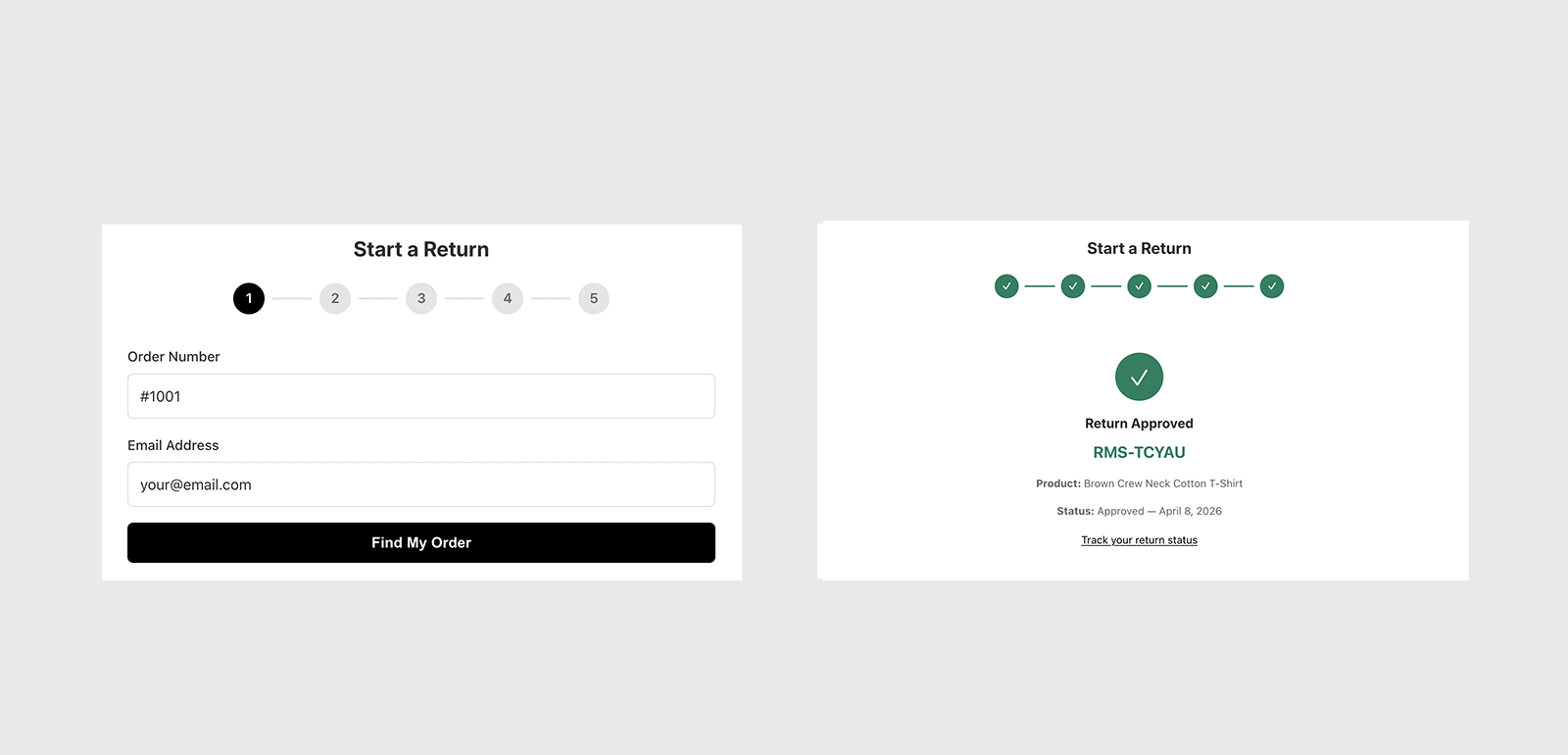
The portal itself should do the heavy lifting: let customers find their
order, select items, choose a return reason, and receive next steps
without contacting your support team. Self-service returns reduce your
support overhead and resolve the customer's problem faster — both of
which contribute to a better post-return relationship.
Closing the Loop with Analytics
A smarter returns process generates data. The question is what to do
with it.
Return rate by product is the most immediately actionable metric. Sort
your catalogue by return rate — not by return volume — and investigate
the outliers. High-return products often have fixable root causes:
a size chart that doesn't account for a particular fit, a hero image
that makes the colour look different from reality, a product description
that overstates a feature.
Credit acceptance rate tells you whether your store credit offer is
working. If most customers are declining credit in favour of a refund,
either the framing needs adjusting or the credit terms are too
restrictive.
Return reason distribution, tracked over time, shows whether product
improvements are having an effect. If you update a size chart and the
proportion of "wrong size" returns for that product falls in the
following month, you have a direct causal link between the change and
the outcome.
These metrics don't require a data team. They require a returns process that captures structured information in the first place — which is exactly what a purpose-built returns tool gives you.
Getting Started
RMS Returns & Credit Manager brings all of this into a single tool for Shopify merchants: a branded self-service returns portal, structured return reasons at the item level, store credit and exchange workflows, and an analytics dashboard that surfaces return rate and reason data across your catalogue.
There's a free plan to get started, and setup takes minutes inside your Shopify admin.